Monday, November 9, 2015

Coffee Pot Soup | Poor as Folk

…#adjunct cookery ~ a series perhaps or companion pieces to #AdjunctStories


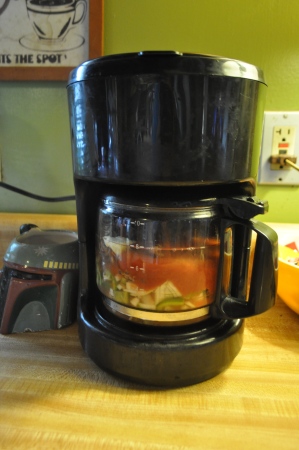
DSC_0522

Foodies of the Internet have since bragged about making gourmet meals in their coffee pots. Obviously, I’m not interested in gourmet cooking. I just need to know if a regular person who can’t afford to replace a broken stove or is living in temporary housing (like a motel) cook themselves good food this way.
Coffee Pot Soup | Poor as Folk

Monday, May 12, 2014

#FarmersMarket Metrics Project for Evaluation

FOR IMMEDIATE RELEASE
Sara Padilla, Project Director
Farmers Market Coalition
sara@farmersmarketcoalition.org
971-533-5143
Farmers Market Coalition (FMC) is excited to announce a collaboration with the University of Wisconsin (UW) to build practical tools for evaluating farmers markets and communicating impacts to local, regional, and national stakeholders. FMC is a member-based 501(c)(3) organization with a mission to strengthen farmers markets for the benefit of farmers, consumers, and communities.

Farmers markets have emerged as important players in the effort to increase consumption of fresh fruits and vegetables, while supporting diversified farms and new businesses. Despite their many benefits, the impacts that farmers markets are having across the country go largely undocumented. Information on the 8,144 markets, with roughly 150,000 vendors and hundreds of thousands of dollars of sales is not being tracked or analyzed in a meaningful way.

The Farmers Market Metrics project consists of two collaborative efforts: identification of effective, consistent data points for measuring farmers market impact, and development of a web-based tool to facilitate the longitudinal collection and communication of those measures. The web-based tool has begun development, as part of the Knight Foundation's Prototype Fund, and now FMC begins a three-year exploration of market indicators with our academic partner, the University of Wisconsin – Madison.

The FMC / UW project team will work with nine markets in three regions across the United States to identify a suite of data points and methodologies for programming into the Farmers Market Metrics tool. The markets selected in each region will test data collection and reporting techniques and receive technical assistance throughout the project. The grant project, called "Indicators for Impact: Farmers Markets as Leaders in Collaborative Food System Data Collection and Analysis," is funded by the USDA's Agriculture, Food, and Research Initiative (AFRI).

An interdisciplinary national team of researchers will advise the project team on the measurement of economic, social, intellectual, and natural impacts; recommending appropriate methodology for their collection and analysis. National Indicator Advisory Team members include Patricia Inman, Ed. D. Senior Research Associate for International Engagement, Center for Governmental Studies (Northern Illinois University); Robert King, Professor, Department of Applied Economics (University of Minnesota); Colleen Donovan, Farmers Market Research Coordinator, Center for Sustaining Agriculture & Natural Resources, Small Farms Programs (Washington State University); Bryn Sadownik, Program Manager of Evaluation and Community Impact (Vancity Community Foundation); Garry Stephenson, Coordinator, Small Farms Program (Oregon State University Extension); Paul Freedman, Associate Professor, Department of Politics at the University of Virginia, and Sarah Blacklin, NC Choices Project Coordinator (N.C. State University) and former Market Manager for the Carrboro Farmers Market in North Carolina.

Darlene Wolnik, Independent Researcher and Trainer with Helping Public Markets Grow, will serve as the Project Research Coordinator. Sara Padilla is the FMC Project Manager and co-Principal Investigator on the project.

FMC Executive Director Jen O'Brien described the Market Metrics Project as "a multi-faceted approach to offering practical tools for farmers markets at the community level. Farmers Market Metrics will help market organizers, market partners, and municipalities understand and efficiently communicate a diverse spectrum of impacts. That collected information will strengthen all food system initiatives."

Alfonso Morales, Principal Investigatorof the USDA AFRI grant and Associate Professor of Urban & Regional Planning at the University of Wisconsin believes that a practical but academic approach to measuring impacts will "help bring an evaluation feedback loop that is often missing in many farmers markets, enhancing market credibility which will enable more effective decision-making."


Sunday, April 6, 2014

The Politics of Food

Consumers should be concerned about where their food comes from. In Food Tyrants (Skyhorse Publishing, 2013), homesteader and writer Nicole Faires recounts her family's adventure to
America's small farms expecting to find inspiration. What she found was
mismanaged land and clueless urban farmers along with the manure-like
scent of a corporation-laced industry.


Using examples from her own life
and offering a brief history of food security, Faires explains how the
food in our plate is no longer "in our hand" and opens our eyes to a wide-scale problem that isn’t going away. With hands-on knowledge and a new view of the American farmer,  shesuggests the answer lays in the soil and provides the information necessary to make informed, healthy food choices.


The selection from Chapter 1, linked below, offers a glimpse into the politics of food that run America: "The Abridgement of Freedom" excerpt: The Politics of Food - Food - Utne Reader
Thursday, February 27, 2014

Why dark chocolate is good for your heart


… New research in the FASEB Journal suggests that consumption of dark chocolate lowers the augmentation index, a key vascular health predictor, and reduces adhesion of white blood cells to the vessel wall

It might seem too good to be true, but dark chocolate is good for you and scientists now know why. Dark chocolate helps restore flexibility to arteries while also preventing white blood cells from sticking to the walls of blood vessels. Both arterial stiffness and white blood cell adhesion are known factors that play a significant role in atherosclerosis. 
What's more, the scientists also found that increasing the flavanol content of dark chocolate did not change this effect. This discovery was published in the March 2014 issue of The FASEB Journal.  
"We provide a more complete picture of the impact of chocolate consumption in vascular health and show that increasing flavanol content has no added beneficial effect on vascular health," said Diederik Esser, Ph.D., a researcher involved in the work from the Top Institute Food and Nutrition and Wageningen University, Division of Human Nutrition in Wageningen, The Netherlands. "However, this increased flavanol content clearly affected taste and thereby the motivation to eat these chocolates. So the dark side of chocolate is a healthy one."'
Read the rest of Why dark chocolate is good for your heart

Tuesday, January 14, 2014

How Cooking Can Change Your Life

…from RSA Shorts—#EverybodyEats so #getsmarter about it. Check out more RSA videos and playlists on other subjects too. Topics include arts, humanities, education, politics, society, science, environment and more, plus webinars, live and replay. I'm particularly partial to the Animates series. Learn more about The RSA and "21st century Enlightenment"

Can you really have your cake and eat it? According to Michael Pollan, you can. In this fun RSA Short, Pollan explains how to eat well by following one simple rule without the need for fad diets or deprivation. 


Michael Pollan is an award-winning food writer whose books include, "Cooked: A Natural History of Transformation", "In Defense of Food" and "The Omnivore's Dilemma,"  Watch Michael Pollan's full talk 'How cooking can change your life' in full at the RSA

▶ RSA Shorts - How Cooking Can Change Your Life - YouTube

Thursday, November 14, 2013

A New Mexico Thanksgiving Dinner

 from @NMMagazine, a menu to have you giving thanks for the state’s bounty of singular ingredients


Back when the Pilgrims were still boys and girls in England, Don Juan de Oñate and his band of explorers enjoyed a feast of thanksgiving in 1598, near Las Cruces, as recorded by Gaspar Pérez de Villagrá, a poet who traveled with the expedition. That’s all the excuse we need for a Thanksgiving feast seasoned in New Mexican style. I always look forward to local flourishes that add zest to the traditional bird and trimmings.

Read the rest of Thanksgiving Dinner in New Mexico Magazine

Thursday, October 24, 2013

Top 10 food facts on #FoodDay


Union of Concerned Scientists
 
Top 10 Food Facts
Share your favorite science-based fact to show your support for a healthier food and farm system in honor of Food Day!
ACTION ALERT
This Food Day, Share the Facts
Today is Food Day! To celebrate, I'm sharing a list of my "Top 10" favorite facts from recent UCS reports, including our brand new report, The Healthy Farmland Diet.

The Healthy Farmland Diet is the first economic analysis of its kind to show how increasing consumption of fruits and vegetables would not only be healthier for our bodies, but also healthier for the environment and local economies. This report also demonstrates how modest government investments can remove obstacles standing in the way for consumers and farmers to reach this goal.

So tell me: what's your favorite science-based food fact? Use the links below to share it on Twitter to show your support of a healthier food and farm system! You can also share all 10 facts on Facebook or by forwarding this email.

1. Healthy farms=win-win-win for health/well being of people, economies & natural resources we all depend on

2. Sales of locally grown food now total $5 BILLION/year.

3. Modest public investments in ~500 farmers markets/year could create >13K jobs over 5 years

4. Got (organic) milk? #Organic dairies = better for environment, consumer health & regional economies.

5. Shifting policy from supporting junk food to fruits/veg could save $17B in health costs
6. Burger with a side of...pills?  >70% of antibiotics sold in US are used in animal agriculture.

7. Only 2% of US cropland is devoted to fruit/veg. Time for smarter gov't policies.

8. If Americans ate fruit/veg according to @myplate, US production of fruit/veg would increase by 88%.

9. Just 1 more serving of fruits/vegetables could save >30K lives/yr.

10. Scientists have shown that cover crops can reduce nitrogen groundwater pollution by 40-70%

As you can see, we've got the facts on our side AND we're making progress because of it. Just last week, we delivered a petition from more than 18,000 UCS supporters to House leadership urging them to proceed with the Farm Bill. They listened, and the Farm Bill process is now moving ahead. Moreover, President Obama listed the Farm Bill as one of his three near-term priorities.

With all of this, we've got a lot to be excited about—and a lot of work to do. Join us, and this Food Day, share your favorite fact now for a healthier food and farm system!
Sincerely,
Ashley Elles
Ashley Elles
National Field Organizer
Food & Environment Program
Union of Concerned Scientists


Monday, September 9, 2013

College Scholarship Opportunities


…for college students majoring in Horticulture, Plant Science or Journalism, with an interest in garden communications. Here's the link:  http://www.gardenwriters.org/gwa.php?p=gwafoundation/student_scholarships.html


Thursday, August 15, 2013

A little gardening update

…from a blog in another part of the country that I follow for my #highered, whither-U & online learning network. Connecting networks - tear down the garden walls - is a current project. Everybody on them eats - and many garden. Re-blogging Steven Krause's here instead of the usual MOOC (Massive Open Online Courses) posts on another blog, MOOC Madness, or composition and teaching writing on yet others
Untitled
last year - getting established

Steven writes,
A break from all the MOOC posting (though I have another brief one of those in me I might get to yet today) to share a Flickr set and an update on the gardening for 2013. 
Part of what prompted me to post this  is this article I came across via the book of face,“Reclaiming the front yard with edible estates” from the public radio show The Splendid Table.   Basically, it’s a little story about a gardening/art project for turning front yards into food gardens. There are even plans for one garden that features an earthen bread/pizza oven. Hmm, maybe next year…. 
Anyway, a couple of quick observations: 
First, it all continues to be a huge hit with neighbors. When I’m out there doing stuff, people walking by routinely stop to chat, to say how much they like what we’ve done, etc. A few other people in the neighborhood have even given the front yard veggie garden a go for themselves. So it’s all very very good.  
Untitled
Second, it grows quick ... Here’s the same view [as above] from almost exactly a year later:
Read rest of A little gardening update by stevendkrause.com

Tuesday, July 30, 2013

the market beet, summer2013 newsletter

…from @FMCorg…w/ usual heads up for the #Mountainair #farmersmarket dba Farm and Market Garden…reciprocity rules even when not reciprocated.
Farmers Market Coalition's quarterly newsletter, Summer 2013

Friday, July 19, 2013

Should Humans Eat Meat? [Book Excerpt]

What can & should be done about human carnivory? Vaclav Smil answers in this excerpt from his new book. Editor's Note: The following is an adapted excerpt of Should We Eat Meat?: Evolution and Consequences of Modern Carnivory, by Vaclav Smil. Wiley-Blackwell, May 2013.
There is no doubt that human evolution has been linked to meat in many fundamental ways. Our digestive tract is not one of obligatory herbivores; our enzymes evolved to digest meat whose consumption aided higher encephalization and better physical growth. Cooperative hunting promoted the development of language and  socialization; the evolution of Old World societies was, to a significant extent, based on domestication of animals. 

Thursday, July 4, 2013

Flash in the Pan: Lessons from the Desert

…A new book explores sustainable agriculture in in dry climates, reviewed by Ari Levaux…must read for local growers and others with an interest in local food sovereignty and water issues.

 
Recent years have brought spikes in the frequency of strange weather patterns and severe storms, with many blaming the increase on human-caused climate change. If this new normal, as it's being called, is here to stay, it will have profound implications on food production.

There are two basic ways that this threat to food production is being addressed. One is to develop new crops and agricultural methods tailored to withstand increased heat and water stresses. The other approach is to look to the past for solutions, at crops and techniques used in regions that have historically endured this kind of weather. A new book by agricultural ecologist Gary Paul Nabhan, Growing Food in a Hotter, Drier Land, is a comprehensive exploration of this latter approach 

Monday, July 1, 2013

Menus: The Art of Dining

…on my way to look for material for a history of BBQ post (for Jubilee's Outlaw BBQ), I came across and couldn't resist this wonderful collection of menus and notes on their history from the UNLV Libraries distracted me from via a post on More or Less Bunk (history blog with a food history category), which comes, in turn, from the Scout Report (not food but a weekly report on best new internet resources, truly an information junkie's delight). That may be more provenance than anyone reading cares about, but all are resources worth looking at more closely.

Menus provide a wealth of information beyond their purely aesthetic value and are a particularly rich resource for aspects of cultural and social history. They give us information on the most popular cuisine of a time period and region and are evidence of changing culinary tastes. They can indicate how particular food items have been used regionally, and in the case of notable restaurants can provide evidence of the work of well-known chefs. 

Wednesday, June 26, 2013

Good for your Garden: Compost

…something for #Mountainair's home & #communitygarden/ers & local growers, especially in the conspicuous absence of either art council as information manager for new community garden consortium or local farmers market updating information or refreshing online content. Normally, Claunch-Pinto SWCD and Torrance County Extension pick up that slack, but the very popular gardening workshop series are on temporary hiatus until Gene Wynn recovers from recent surgery. 

After starting a Community Garden playlist and subscribing to gardening channels, I then forgot to add videos to the playlist. I now stand reminded and have just added more videos, subscribed to more channels...


Notes from Praxxus

Saturday, June 8, 2013

Ice Cream Bread

…from my friends & fellow cyber gourmands at Coursera Café

Ice Cream Bread
adapted by Cooking with Libby
Ingredients:
2 cups of your favorite ice cream, softened
1 and 1/2 cups of self rising flour
Directions:
Preheat your oven to 350 degrees.  Grease and flour an 8×4 inch loaf pan.
Mix the ice cream and flour together in a bowl just until combined.  Smooth it out so it looks even.  Bake for 45 minutes or until toothpick inserted comes out clean.
Cool for a while and then serve.
Recipe Tip:  For best results, use full-fat ice cream.
It should also be noted that some flavors of bread will come out stronger tasting then others.  For a bolder and not so plain flavor…it is recommended to go with bold flavors of ice cream such as peanut butter or butter pecan.  Don’t forget, you can also add extra ingredients into the mix to make it less plain and more flavorful.  Experiment and have fun with it!

via Ice Cream Bread - Newlyweds

Friday, June 7, 2013

From BlogHer: Food Bloggers & Best Food Writing

…not to be confused with Everybody Eats, which is more of a curation project and eclectic compendium. It all started with a few feeds in the reader, mostly related to local food sustainability, community gardens, and links to share to a friend's food page on Fb. She lost interest and canned the page. So there I was with all these food feeds and no place to send them...

Tuesday, May 21, 2013

Gardening video: planting sweet corn

…how does your garden grow? From #communitygarden novices to experienced home kitchen gardeners, farmers market growers, professionals and permaculturists…'tis  the season when thoughts turn to gardening. Claunch-Pinto and Torrance County Extension have been collaborating in gardening workshops. Since the June workshop has been postponed and the series on hiatus with Gene Winn recovering from hip surgery, perhaps we all can help fill the gap here with videos, resources and gardening tips. Topics and recommendations invited.


In today's episode you and I will plant Ambrosia Sweet Corn. Join me in the garden for a slightly different method of planting corn for a stronger healthier plant. Stay tuned for many updates on this. Hopefully it ends with me grilling fresh corn on the barbeque this summer. 
Gardeners also share tips on the Facebook page. Here's an interesting one that reminds us how much gardening is the ultimate recycling:
"I am growing potatoes in horse feed bags. They are doing great so far. I rolled the bag all the way down to start, added straw in the bottom then a layer of soil enriched with compost, planted and now as they grow I am alternating straw and soil."

Tuesday, May 14, 2013

Harvard goes haute cuisine…scientifically

…in a course about SCIENCE & COOKING: FROM HAUTE CUISINE TO SOFT MATTER SCIENCE


Science & Cooking brings together top chefs and preeminent Harvard researchers to explore how everyday cooking and haute cuisine can illuminate basic principles in physics and engineering, and vice versa.
During each week of the course, you will watch as chefs reveal the secrets behind some of their most famous culinary creations — often right in their own restaurants. Inspired by such cooking mastery, the Harvard team will then explain, in simple and sophisticated ways, the science behind the recipe.

Friday, May 10, 2013

Pie Multi-Tools

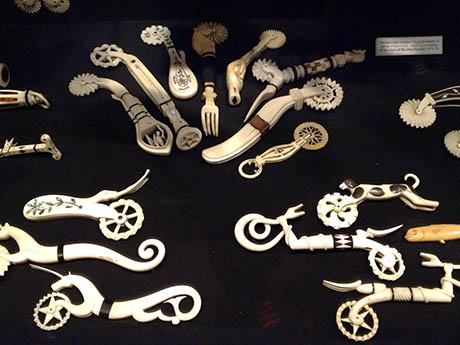
…Behold the missing link between Martha Stewart and Moby Dick: the scrimshaw pie multi-tool.

6 Pie Crimpers 460

On a recent Venue visit to the New Bedford Whaling Museum, I was captivated by a gallery filled with scrimshaw items, carved by American nineteenth-century whalemen as gifts for mothers, wives, and sweethearts during their long sea voyages....[S]crimshanders carved baleen, walrus tusks, and whale teeth into hundreds of thousands of pie crimpers.

Read the rest at Pie Multi-Tools at edible geography, Everybody Eats' latest food related blog find

Thursday, May 9, 2013

10-layer roasted vegetable salad

…for those not that into grazing raw vegetables. Salads don't have to be 100%  raw. This one looks interesting. With the Mountainair Farm & Garden Market now open (even if reports do run to information skimpy and content lite) and the community garden (no link, FB page not being maintained) getting busy, it's time for Everybody Eats to get with it too.  Farmer market and community garden posts will appear here, on Mountainair Online (the blog) and, to a lesser extent, iCreate ~ all syndicated to Mountainair Online (the Facebook page). Enough already...onto the salad course…

Every single bite of this salad is a new and wonderful flavor combination, depending on what lands on your fork. The delightful mix of roasted vegetables, beans, crispy lettuce, crunchy toasted almonds, smooth avocado and tangy feta cheese -- all combined with a dressing of garlic, honey and spices -- is an incredibly tasty and healthy feast.

There are a few steps to making this salad, but it comes together quickly....This recipe is adapted from The Fresh & Green Table by Susie Middleton.

Continuea at 10-layer roasted vegetable salad [Vegetarian] : TreeHugger